The ‘what’, the ‘how’ and the ‘when’ to learn
2026-03-01
I’ve spent the last month preparing to start studying. I’ve never spent so much time doing structured procrastination, but I actually feel better for it. I’ve been reading about study techniques, buying the books, preparing a preliminary study timetable, reading some introductory chapters and generally gearing myself up mentally for studies. Basically, everything except actually studying calculus, but you know.
I’ve decided to study entirely through MIT’s OCW, mainly because nothing else comes even remotely close in terms of openness, completeness, and the standard of education that MIT has. Stanford, for example, has their SEE, which is hopeless. But also because it is easy for someone like me to fall into analysis paralysis.
Last year, I spent January studying Thompson’s ‘Calculus Made Easy’ because it was, by all accounts, the most approachable text on Calculus. I loved it. I would wake up every morning at 05:30, pour myself some corn flakes, and study for an hour or so before getting ready for work. I spent most of the time solving problems, and would often turn to Octave to make some toy scripts to supplement my understanding.
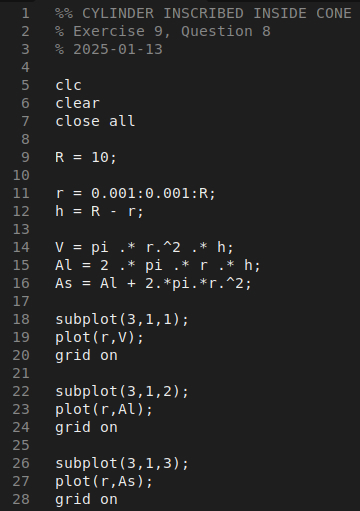
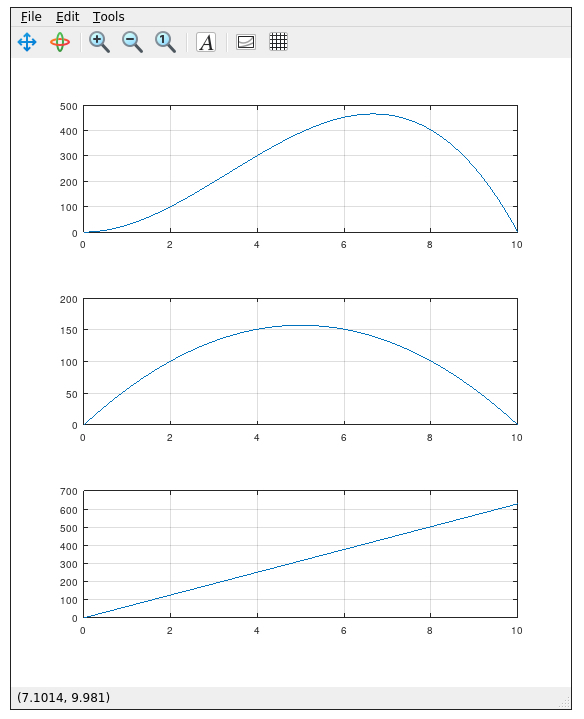
It was all very nice. But when I finished the book, I got torn between what to study next. Should I study Spivak, the God that everyone adores but fears? Or should I do Stewart’s or Thomas’ calculus, those university workhorses that are 1000 pages each? Or should I just skim Paul’s Online Notes? Ultimately, I could never stop flitting between each of these resources, until all the motivational steam had dissipated, and I had gotten nowhere.
So, this time, I’ll keep my horse-blinkers firmly in place and not look left and right for other resources.
The what.
For the first year, I’ve decided to limit myself to just these subjects:
- Single-variable calculus
- Multi-variable calculus
- Classical mechanics
That’s it. If I could properly nail these, I would consider it a resounding success.
Here’s a fuller list of Maths subjects I plan to study gradually:
- 18.01 Calculus 1: Single variable, limits, differentiation, integration
- 18.02 Calculus 2: Multi-variable calculus
- 18.02 Calculus 3: Line, surface and volume integrals
- 18.03 Differential Equations
- 18.06 Linear Algebra
- Vectors and Tensors
OCW courses for the first five exist and are listed. The last one might have to be tackled as-and-when I find need for it in the Physics or Mechanical Engineering courses.
For Physics, Classical Mechanics gets you far enough as a mechanical engineer. If you are studying things more exotic stuff like Orbital Mechanics, you might need Relativiity. Material scientists might need Chemistry and so on. Me, I will stick to classical mechanics for this year.
MIT packages fundamental Physics into three subjects:
- 08.01 Classical Mechanics
- 08.02 Electricity and Magnetism
- 08.03 Waves and Vibrations
My grandest ambitions involve studying all of them, but that is a problem for Future Me.
I’ve bought the books for 18.01 (and 18.02) (Simmons) and 18.06 (Strang). CERN’s library has, very likely, a copy of every possible Physics book you could think of. Certainly, Kleppner and Kolenkow’s ‘An Introduction to Mechanics’ needed for 08.01 was freely available, so I’m set for books for this year.
The first subject I’ll be studying, then, is 18.01 Single Variable Calculus. The Fall 2006 version, which can be found on OCW here. I chose this because it has the video lectures present.
The how.
I wanted, first, to understand how to learn Maths and science. YouTube is bursting at the seams with videos by medical students about how they aced getting into Cambridge using Anki. The problem is, understanding medicine seems to me nothing like understanding Physics and Maths. Maths, I think, is too fundamental to be amenable to being studied off of flash cards and in Physics, understanding what is going on is crucial. In medicine, you cannot keep asking ‘why?’ too much because, sooner or later, you will arrive at ‘it’s just the way it is’. I think you can keep going with the ‘why’ question in Physics long after you cannot in medicine.
And so, I read through Scott H. Young’s ‘Ultralearning’ and Barbara Oakley’s ‘A Mind for Numbers’ hoping for some insight. I was disappointed. Both are too unspecific, not prescriptive enough. Nowhere in either book lies a clear, step-by-step description about how to actually structure your studies. What should I actually do when I sit down to study? What am I doing before a lecture, during a lecture, after a lecture? Do I start a session with active recall? Or am I doing practice problems? What’s a good ratio? What’s the difference between studying Maths and Physics?
I expect the answer for all this will be “figure it out for yourself”. I’ll have to experiment and see what works, and that is part of the motivation for going extremely slowly this year. Still, here’s my current best understanding of how to study:
Teaching is learning: If you learn as if you are required to teach the subject, you will learn it better. In practice, this means writing out the concept by hand, from memory, without any material, in as much detail as you can muster. This is also known as Active Recall, and it beats Passive Reading where you reread the material a second and a third time, hoping to grasp it.
Practice makes permanent: I met a couple of Physicists at a recent party, and their recommendation was that the way to learn Physics is to do lots and lots of practice problems. This advice, therefore, applies to both Maths and Physics. But, a word of caution about overlearning. Once you’ve truly gotten a topic, there’s little point in continuing to go through the motions of doing more problems on the subject. Better to do something else (interleave) or leave it alone for a while and come back after a period of time to see if you can still do the problems (spaced repetition).
Testing yourself is good: Apparently, testing yourself even before you’ve learned anything about the subject is still beneficial. It primes your pumps for learning. What I take it to mean is that, at the start of a session, or of a new chapter or the introduction to a concept, it is worth skimming over the list of topics, and then closing the book and writing out by hand all that you know about the subject.
Rest properly: If you’ve finished a bout of learning, don’t jump into video games or another mentally straining activity. The more relaxed you can be, with periods of proper leisure, the better the chance the material has of assimilating in your brain.
So, how am I going to study? My first idea is this. Start each session by reviewing the last session. Try to list out the major bullet-points cold, without consulting the material. Then, try one or two problems from last time, nothing more than ten minutes of work.
After that, skim through the current reading material. What am I going to be studying here? Then put the material away, and try to write down or recite all that I know about the subject, as if I had to teach it. This act of recitation often highlights the gaps in my thinking, things I don’t quite get, thus priming me for keeping an eye out for them while reading.
Once the reading is complete, try to do the problems. Do the example problems without looking at the solutions, and then the real problems. Do as many as I can, but not an exaggerated amount of them. Instead, use that time to do problems from the last session, to keep it fresh in my mind.
Once the session is complete, do not jump on to the internet. Read a book, listen to some music, or, on the weekends, play my guitar and bass or go for walks etc. Spend time with my fiancée.
For the actual studying tools, I’m going to use just one notebook, a scratchpad. Nothing is going to be precious or neatly done except for the exams and assignments, which will be on loose sheets of paper. My calculator is near-at-hand always, recently refreshed with a new battery. Python and Octave are always available for quick plots. Beyond that, I will use the internet to try to understand anything that isn’t clear from the books and lectures. Sometimes, I’ll use Wolfram Alpha for problems I simply cannot solve. I don’t have the solutions manual, so I might need this ocassionally.
The when.
MIT estimates that a 1-unit course requires one hour per week of effort from the student. 18.01 is a 12-unit course, meaning I’m expected to put in about twelve hours per week on it. Given that the MIT semester is fourteen weeks long, this gives 12 × 14 = 168 hours of work (nicely packaging into ‘a week of your life’).
MIT also helpfully assigns courses as something like ‘5-0-7’, meaning five hours of lectures (per week), zero hours of lab, and an estimated seven hours of self-study, or roughly an hour and a half of study for every hour of lecture. I’m slower than most, so I’m accounting for double that time.
Lectures
The lectures are thrice a week, an hour each. Twice a week, there
are ‘Recitation’ sessions which are like TA office hours where
students can do live problem-solving and ask all that they desire.
The total is thus five hours a week.
Of the expected 14 × 3 = 42 lectures, there are four exam reviews, four exams, and one final exam. Meaning there are about thirty three lectures of actual study material. I will watch them at 1.5× speed, rewinding to grasp better as necessary, and using the time gained to review material in my head at the end of the lecture.
I will watch the lectures during lunch at work thrice a week. Circumstances not conspiring, this will be Monday, Wednesday and Friday.
Reading Assignments
MIT helpfully tells you what to read before each lecture, and it
is either text from the textbook, or the notes from the lecturer.
I have the lecture notes downloaded (actually, you can download
the entire course as a zip file, which is just amazing).
I will be doing my readings in 90-minute sessions Monday through Friday from 05:30 to 07:00 before work.
Problem Sets
There are eight problem sets. This being MIT, I fully expect them
to take a lot of time. A big unknown for me is how to make sure I
finish them on time. I have not scheduled them and will have to
see week-by-week where they fit. My hope is that I’ve been
generous in scheduling three hours of reading for an hour of
lectures, so I can steal some time during them, otherwise I’ll do
them on weekends.
The Psets are to be handed in on Fridays, but in my schedule, they are simply linked to where the lecture video corresponding to the deadline happens to fall. You’re allowed to hand in one Pset late without penalty, and I might use that. Also, I understand that you have the next Pset available as soon as the previous one is submitted, so I fully plan to open them up and see how much I am able to do immediately upon reception.
Exams
There are four in-class exams of fifty minutes each. Unbelievably,
MIT even has practice exams for the exams. I will
definitely make use of these as I prepare for the exam.
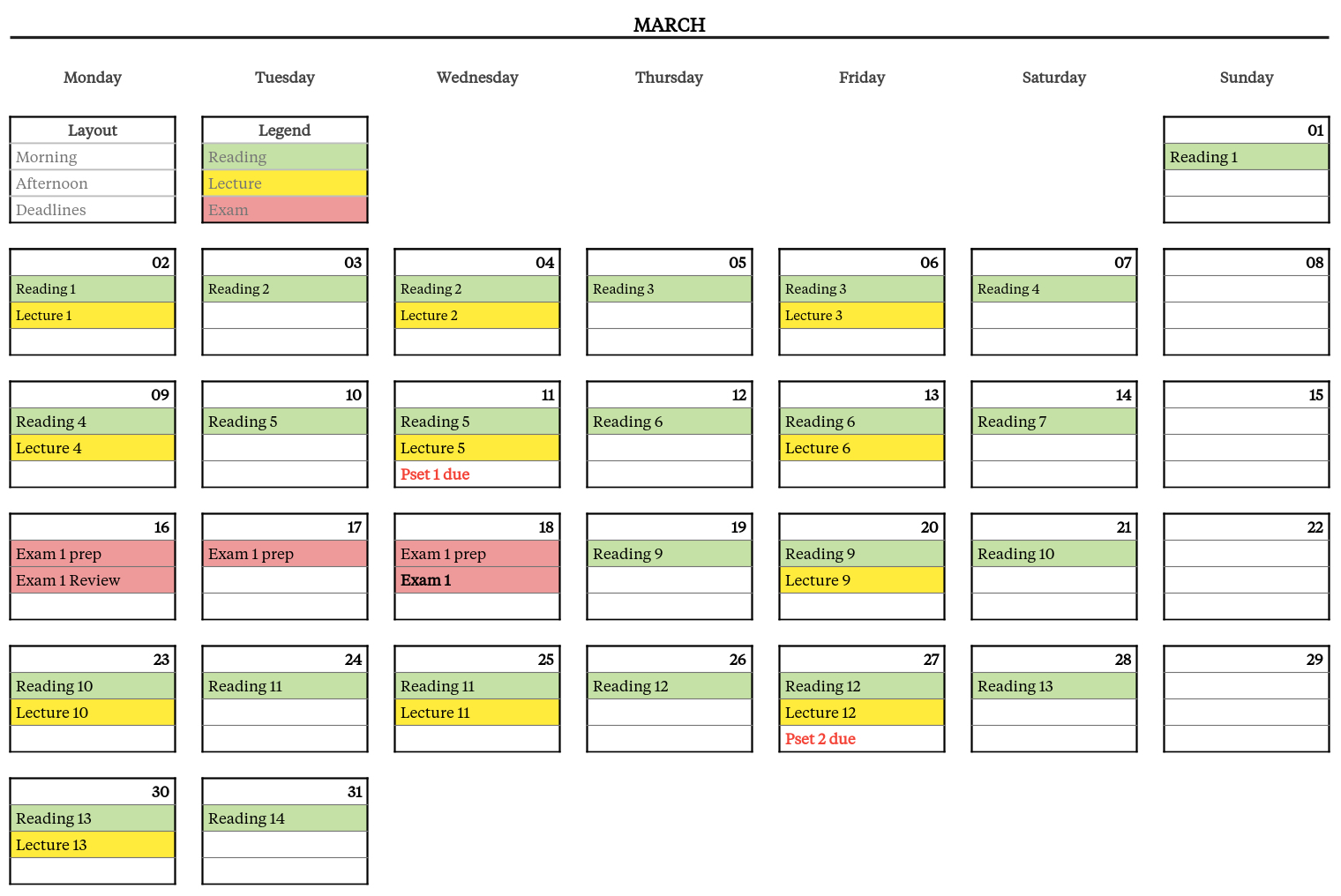
Putting it all together, below is my tentative schedule for March. You might have to enlarge it. I have a second copy of it that is blank, where I can fill in what I actually managed each day. At the end of the month, I can compare the two to get an idea of how fast or slow I’m going.
One last word on the OCW. I cannot believe a resource like it exists, and exists for free. To me, this represents the pinnacle of human achievement, of the internet’s power to empower. I love this so much that I donated twenty five dollars to them, although I doubt that they will need it.
At any rate, the time has come for the talking to stop and the studying to begin. I will report back in a month.