Kickoff
2026-01-31
Over the coming years, I hope to use this project as a learning tool, an accountability tool and persistence training.
I did not have good grades in school or college. Actually, I had terrible grades. In college, every semester I would come back from holidays determined to do better and get good grades, but a week in, I would be back to my old habits of endless video games and procrastination. It was a terrible, guilt-ridden time. As a consequence, my education has been shaky, and no good foundations have ever been built. Without good foundations, you cannot get very far in Science. In Maths and Physics and Engineering. Everything builds upon everything else, so if you already stumble on calculus, differential equations, vectors, linear algebra or classical mechanics, that’s it. You can fumble around with the rest of the subjects, but it won’t amount to much. Good foundations are essential.
The wider the base, the taller the building.
My goal with this project is to slowly, however imperfectly, work on improving my engineering foundations. To revisit the fundamentals. This time with better knowledge, better study techniques, better motivation. Twenty years since I started university. I have less hair than I did back then, more of it is grey. I hope this will hold me in good stead.
I will attempt to catalogue my progression with (roughly) monthly updates.
This quest is, of course, inspired by Scott H. Young’s MIT Ultralearning challenge. While he focussed on computer science, my focus will be mechanical engineering. But like him, I will generously use the MIT OpenCourseware (OCW) resources.
For the first month, the task is just to learn how to learn. So, part of the syllabus is also to read through Barbara Oakley’s ‘A Mind for Numbers’ and ‘Learning How to Learn’ books, along with ‘Ultralearning’. Any other resources that I can find about how to study maths and science will also be taken on, including Youtube videos or ChatGPT.
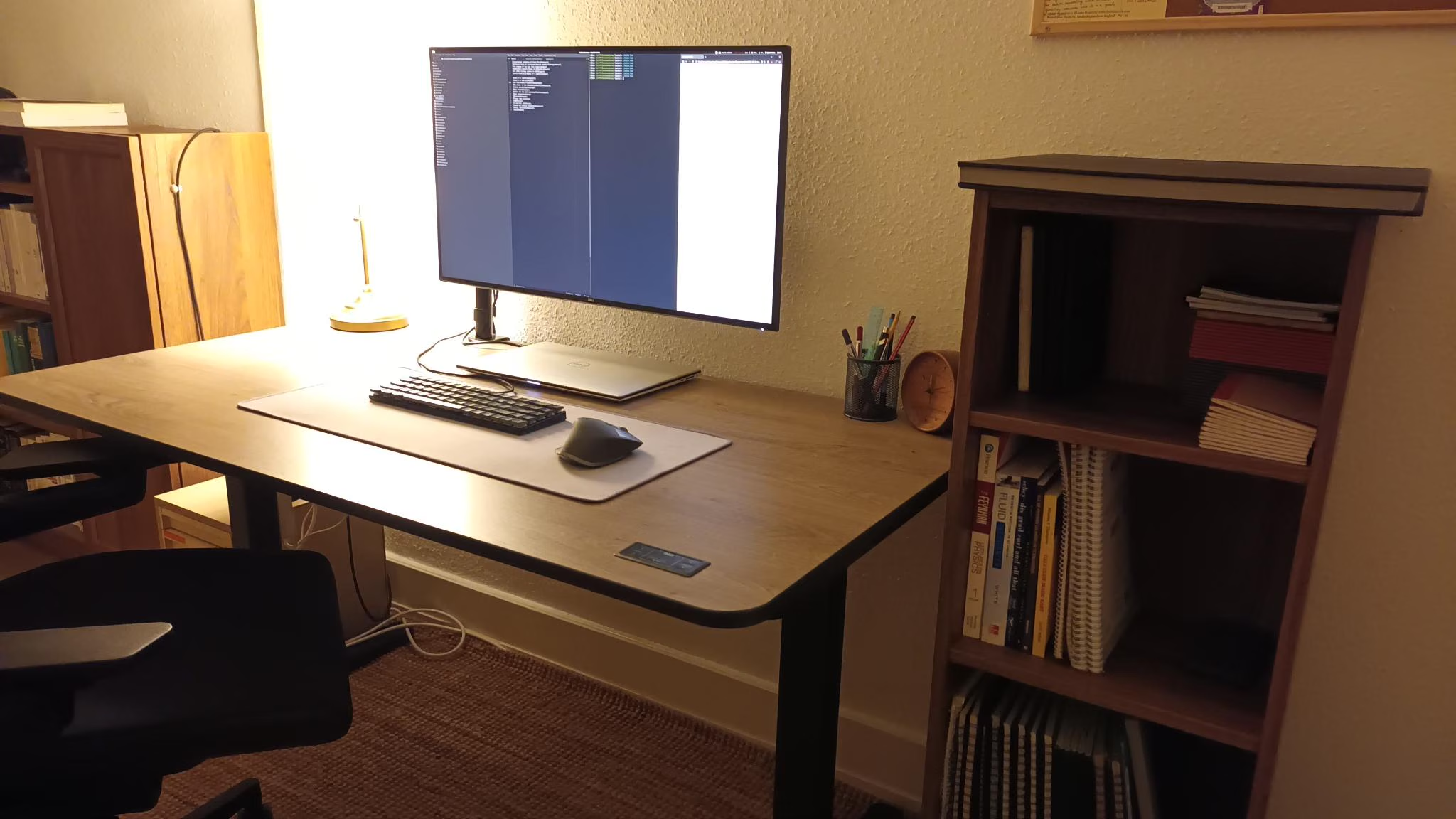
The task is also to ‘define’ the project better. Establish what I will and will not cover, how long I expect things to take, how much time am I willing and able to spend per week on it, how will I fit in the testing, which books will I need and so on. To gather all notebooks and pens and calculators.
I look up to places like MIT, Stanford, CalTech (I heard it said that you don’t graduate from CalTech, you survive CalTech), and Georgia Tech. I hope to go through their undergraduate Mechanical Engineering syllabi and prepare my own Frankenstein’s monster version of them.
Welcome to The Foundations Project.